


Many small and mid-sized vertical software companies specializing in particular industries now share a common challenge: finding their next leader. This is not limited to manufacturing or food services. Across the Japanese IT sector, founders who launched their businesses in the 1990s are increasingly considering generational transitions as the AI era approaches.
Micronity is confronting this challenge head-on with a thesis centered on “AI × business succession.” The company estimates that there are 3,000 to 4,000 such profitable vertical software companies in Japan.
Unlike traditional private equity funds that focus on post-acquisition cost-cutting to generate returns, Micronity works alongside acquired companies to drive business automation through AI agents. In roughly one year since its founding in April 2025, the company has consolidated five firms into its group, raised a cumulative ¥2.2 billion, and grown its ARR to approximately ¥2.5 billion (as announced by the company on March 31, 2026).
Micronity is the third venture for CEO Yuichiro Yamazaki, having earlier founded two companies including Metaps Holdings.
Describing this as his “final challenge,” Yamazaki recently welcomed MUFG Innovation Partners (MUIP) as a new shareholder. We spoke with him about the founding story, the business model, organizational design, and his expectations for collaboration with the MUFG Group.
Founding story and how the AI × Business succession ecosystem is addressing a long overlooked generational shift in the IT sector
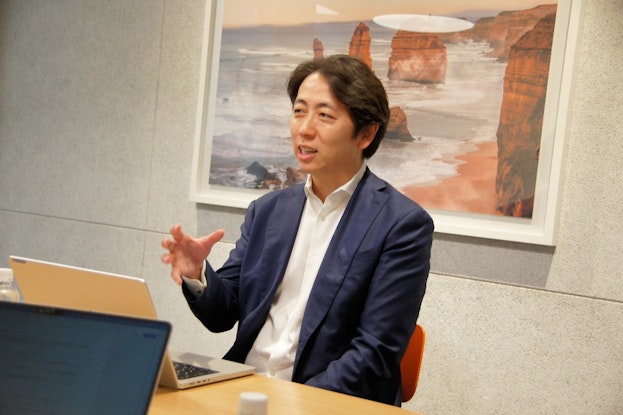
In conceiving the business, Yamazaki started from a core conviction: “To build something truly large, you must solve the largest social problem.” He identified Japan’s greatest structural challenge as population decline and the resulting succession crisis, a problem that is now spreading into the IT industry.
The single biggest issue facing Japan is depopulation, and the succession problems that come with it are now surfacing. Many people associate succession issues primarily with manufacturing, food service, or nursing care. But over the past few years, we have been seeing a growing number of cases where tech entrepreneurs who founded their companies in the 1990s are beginning to consider stepping down. (Yamazaki)
Two key factors are driving this trend. First, the rise of AI has produced a cohort of founders who feel that a major game change is underway and want to hand the baton to the next generation. Second, IT industry executives tend to retire relatively young. The recent retirement of Susumu Fujita from CyberAgent, who stepped down as president in his fifties, is one example of a broader pattern.
For publicly listed IT companies, the answer is simply to designate a successor. But for unlisted small and mid-sized firms, finding a successor is far more difficult. They are often too small to attract PE fund interest, and founders themselves frequently express a reluctance to sell to competitors, funds, or foreign entities.
Until now, there have been few suitable acquirers in the domestic market. The IT sector also lacks a tradition of passing the business down to family members, and it is rare for a second-in-command to take on the financial burden of acquiring shares outright.
In the tech sector, there is simply no culture of passing the business to a second or third generation. And even when a candidate exists, it is rare to find someone willing to take on debt to acquire the company. In practice, what usually happens is that shares are transferred while the number two person continues to run the business as president. (Yamazaki)
Micronity’s vision is to build a new ecosystem for business succession through AI. Yamazaki describes the foundational premise of the company’s business design as follows:
In the past, PE funds and other succession players would typically acquire a business, cut costs to improve profitability, and then sell it to a third party. But in Japan, regulatory constraints and cultural norms make it difficult to conduct significant layoffs or aggressive cost-cutting. More fundamentally, most small businesses are already understaffed. Micronity’s approach is different: we combine AI with existing businesses to drive not just efficiency gains, but further growth. (Yamazaki)
Beyond conventional back-office and sales support, the company’s most ambitious undertaking is the full automation of business operations through AI agents.
Micronity uses its group companies as proof-of-concept environments to test the boundaries of automation. Its targets are B2B vertical software companies in sectors where the operations of marketing, inquiries, sales, contract management, and customer success follow standardized, repeatable patterns that are well-suited to AI.
Yamazaki sees particularly significant potential for AI agents to handle technical support queries that arise during contract periods, given that much of this work is text-based and processed through distributors.
Six completed acquisitions: Focusing on niche sectors that AI cannot easily disrupt
Micronity has completed a total of six M&A transactions.
Its most recent acquisition is Beeline (founded by Akinori Saito), a company that provides electronic medical records and image examination filing systems for ophthalmology clinics across Japan.
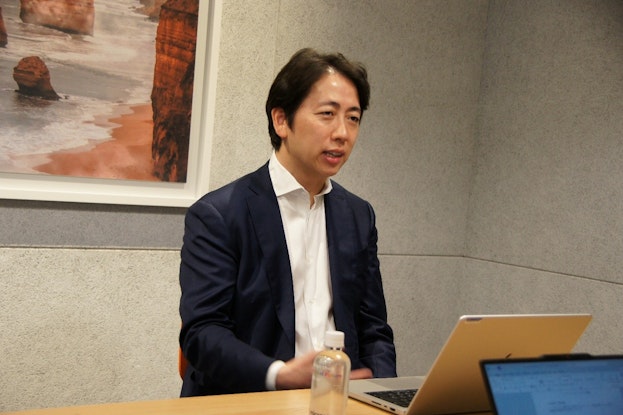
This company has been deeply embedded in the ophthalmology sector for nearly 30 years, selling proprietary software. The founder was personally driving sales—traveling to locations across the country about three days a week. It was an organization that could not function without the president. They had struggled to hire management-level talent capable of serving as a right-hand person, so we are actively supporting recruitment, leveraging Micronity’s brand and hiring capabilities. (Yamazaki)
The challenges each company faces are not uniform. According to Yamazaki, the most common issues involve recruitment and the shift to cloud-based and AI-driven systems, but concerns range broadly across marketing and development infrastructure.
Micronity estimates the domestic market for vertical software companies at 3,000 to 4,000 firms and is pursuing an approach of bringing a meaningful share of them into the group.
On international expansion, Yamazaki observes that “the countries with a mid-market software vendor ecosystem are essentially limited to four regions: North America, Europe, Japan, and Australia.” In most other markets, large conglomerates or national champions dominate the space. While the company has long-term ambitions to expand into Asia Pacific, beginning with Australia, its immediate focus is on consolidating its domestic foundation.
One reason for targeting this segment is its relative resilience against AI disruption. Yamazaki explains:
I believe that niche vertical markets are among the sectors least likely to be displaced by AI. The reason is that distribution channels in these industries are extremely difficult to penetrate, and even a well-funded AI startup would struggle to break in. In the case of ophthalmology software, for example, the traditional adoption process involves running seminars with prominent professors at national university eye departments, who then present their findings at academic conferences, prompting ophthalmologists to evaluate the product. That kind of industry-specific adoption pathway can’t be replicated by AI. The more niche, the better—that’s one of our core strategies. (Yamazaki)
A platform strategy built on full AI automation operating in the background
Over the medium term, Yamazaki envisions creating at least one company that runs entirely on AI agents.
One existing group company distributes all its products through agents and has no in-house sales organization. Yamazaki believes that if marketing, customer success, order management, and accounting can be fully automated, the business can sustain itself operationally.
I want to build one company that runs entirely on AI agents. That, to me, is what ‘AI × business succession’ truly means. The ideal state is a single business head, with everything else running automatically. (Yamazaki)
Currently, the company is developing an “AI CTO”-style agent by training an LLM on the technical inquiry data accumulated by a former CTO. Since most inquiries arrive via agents as text, there is minimal resistance to AI-generated responses.
The AI’s accuracy rate for technical questions already exceeds 70%, and the company is building an AI agent architecture that autonomously continues validation to further improve precision.
Micronity's operating philosophy is simple: each company takes center stage, while our role is to support them from behind the scenes. After an acquisition, day-to-day operations are fundamentally left to each company under a decentralized, autonomous model, with support from us provided on a request basis. For example, companies that need a CEO successor can receive internally groomed executives or candidates from a pool of seasoned professional managers. Yamazaki describes this philosophy as follows:
In a typical M&A, the acquirer tends to assume a dominant position. We consciously push back against that. Our framing is not that ‘Micronity is the buyer,’ but rather that companies are joining the Micronity platform and ecosystem. We also discourage language like ‘parent company’, ‘takeover’, or ‘headquarters’ internally. (Yamazaki)
Group companies are the protagonists, and Yamazaki himself deliberately avoids a high public profile. The goal is to establish “Micronity” as the name synonymous with business succession—building the brand around the platform rather than around any individual.
AI adoption within the corporate function is also advancing in parallel with operational automation across group companies. Kazunari Komoriya, formerly CTO of JMDC, leads the AI promotion organization (M-Lab). In addition to improving efficiency within Micronity itself, M-Lab conducts workshops at each group company to drive the adoption of LLMs and AI-driven development practices.
Organizational design is also being structured with the medium and long term in mind. Over that horizon, the plan is to segment operations by intermediate holding company, distributing the M&A function by industry (construction, municipalities, healthcare, etc.) and geography (Australia, Singapore, etc.).
Each intermediate holding company will need its own CEO, CFO, and M&A infrastructure, and so the company is recruiting actively from both new graduates and experienced hires with a focus on individuals who aspire to run a business one day.
Within three years, we expect Micronity at the parent level to stop conducting M&A directly. Going forward, that activity will be driven by each intermediate holding company. (Yamazaki)
In a typical startup, senior roles quickly become saturated, limiting promotion opportunities. At Micronity, as intermediate holding companies multiply, executive positions open at each one. There is growing interest from department-head-level executives at large corporations who are attracted to the experience of running a smaller business, and the company is using those opportunities as a recruitment draw while simultaneously hiring AI engineers.
Yamazaki notes: “No matter how large the group becomes, I plan to spend the next year developing the organizational and talent strategies that will allow each company to operate with speed and agility.”
High hopes for collaboration with MUFG Innovation Partners
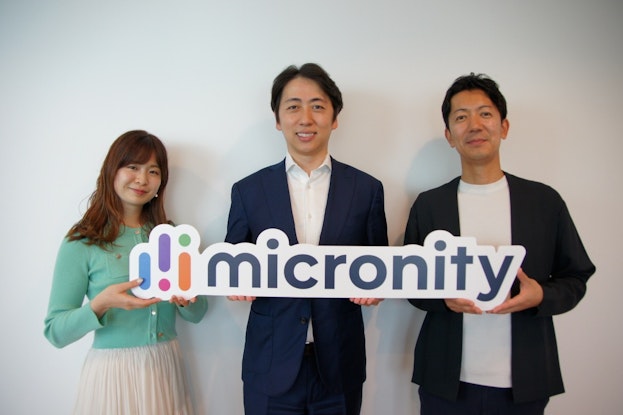
Reflecting on his decision to bring MUIP on as a shareholder, Yamazaki identifies three strategic rationales: M&A financing, global expansion, and the credibilitythat comes with the MUFG Group brand.
M&A financing is the most critical theme in Micronity’s strategy. Speaking to both this and international expansion, Yamazaki says:
This is a business that requires continuous fundraising, including future rounds. MUIP strikes me as a CVC that can engage constructively on that front. I am counting on them for support in structuring the next financing round, as well as for their local networks and connections when we expand internationally. (Yamazaki)
The third point is credibility and the potential to deploy group software within the MUFG ecosystem.
For a startup, having the MUFG Group as a shareholder carries real weight. From the perspective of business owners considering succession, seeing your name among our shareholders provides a meaningful sense of reassurance. We also have a wide range of software products, and I would like to explore opportunities to deploy them within your group. Most are highly niche—like electronic medical records, which would not be directly applicable—but where there is a fit, I would welcome the chance to explore adoption. (Yamazaki)
In roughly fourteen months since its founding, Micronity has brought six companies into the group. Over the next three years, the key question will be how far the company can advance two parallel ambitions: distributing its M&A infrastructure across intermediate holding companies and establishing a live example of an AI-agent-only business.
