


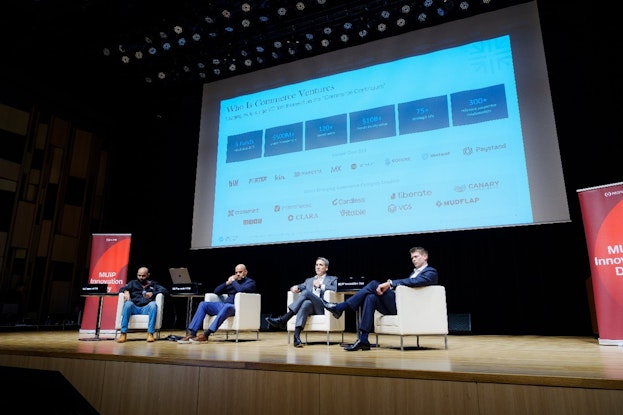
At the MUIP Innovation Day 2026 session titled “Finance × Generative AI: Latest U.S. Use Cases and Perspectives from a Specialist VC,” Dan Rosen, Founder and General Partner of Commerce Ventures, and Ysbrant Marcelis, Partner, took the stage to share their observation of two dominant themes – tokenization and AI, which are shaping the U.S. fintech market today.
Since its founding in 2013, Commerce Ventures has backed more than 120 companies at the thematic intersection of finance and commerce. This article explores the three key areas highlighted by Dan and Ysbrant – stablecoins, tokenized deposits, and security tokens – to paint a full picture of the transformation unfolding before U.S. financial institutions.
Explosive growth in stablecoin use driven by real-world demand
The first area highlighted was stablecoins. Adoption is accelerating at the implementation level, driven by real-world business needs such as real-time cross-border remittances between consumers, as well as instant payments to global contractors and employees round the clock.
This is no longer a technology in the development stage. Real business value is what’s driving it. (Dan)
Commerce Ventures has been tracking stablecoin payments as a theme for roughly two years. Through the firm’s meetings with leading financial institutions and entities, it has identified a number of specific material threats and risks to banks. Commerce estimated that many U.S. super-regional banks could face 2~3% of their net interest income impacted.
If you think about it from a per-share performance perspective, that’s a very significant impact. (Dan)
U.S. banks are responding through three strategies.
First, they are actively working on tokenizing deposits. To counter the risk of payment volumes flowing to stablecoins, banks themselves are tokenizing deposits to reclaim sovereignty.
Second, because stablecoin companies in the U.S. still need regulated banks as back-end infrastructure, banks are becoming partners to these firms and providing fiat-currency gateway accounts.
Third, banks are white-labeling stablecoin capabilities and monetizing such actions by offering them as a service to corporate and enterprise clients.
Tokenized deposits and security tokens as infrastructural reform to reclaim banking sovereignty

The second key area highlighted is tokenized deposits, which carry a strongly defensive connotation for banks. In the face of payment demand migrating to stablecoins, banks are tokenizing their own deposits to reassert sovereignty over payment infrastructure.
Commerce Ventures has gleaned from conversations with more than 20 of its strategic investors, including MUFG and major payment networks, that the sense of urgency among banks is extremely high. Ysbrant suggested that tokenized deposits are rapidly becoming a pressing strategic priority for banks.
The third key area is security tokens. Alpaca, which took the stage later at the same event, was introduced as a leading example in this space. Dan noted that although these three areas are at different stages of adoption, “rapid commercial traction is visible on a global scale.”
While security tokens are at an earlier stage of adoption compared to stablecoins, they have the potential to streamline existing securities settlement infrastructure.
AI-driven productivity revolution and cost pressure
Besides tokenization, Commerce Ventures devoted significant time to discussing the growing adoption of AI. The areas where major U.S. financial institutions are most focused on AI are cost reduction and productivity improvement.
When we talk to the top 20 U.S. banks, we hear things like ‘we want to cut 200 credit analysts’ or ‘we have a 20% enterprise cost takeout target at the board level. (Ysbrant)
Ysbrant outlined three stages of AI adoption. At the most basic level, enterprise tools such as ChatGPT and Cursor are used internally as general-purpose AI tools. At the intermediate level, incumbent vendors are replaced by AI-powered alternatives.
At the most advanced level, specialized AI capabilities designed for bank-specific workflows are deployed. Ysbrant stated that all of the top 20 U.S. banks have deployed enterprise ChatGPT, Anthropic or Copilot, and roughly 80% of them have either implemented or are in the process of implementing some form of AI-powered functionality. Between 50% and 90% of employees at major banks are using AI on a regular basis to boost productivity.
Dan quoted a remark by Sakana AI’s Llion from an earlier session to drive the point home:
You don’t need to worry about losing your job to AI. But you should worry about losing your job to someone who uses AI. (Dan)
The case of Block (formerly Square), which announced a 40% workforce reduction, yet experienced a 25% stock price increase, epitomizes both the speed of this transformation and the pressure from shareholders.
The emergence of AI-native financial institutions not bogged down by legacy systems

Commerce Ventures outlined three phases in the history of U.S. fintech investing, which is essential for understanding the outlook for AI-native banks. In Phase 1 (from 2013), investments centered on next-generation infrastructure companies, such as Bill, Marqeta, and Socure, that replaced mainframes and legacy batch-processing systems. In Phase 2, next-generation financial institutions like Robinhood, Chime, and Brex were built on top of that infrastructure. Now in Phase 3, the two forces of tokenization and AI are poised to redefine financial infrastructure itself.
Commerce Ventures is watching closely the emergence of next-generation financial institutions – AI-native banks – built from scratch on AI infrastructure rather than legacy technology. In the U.S., regulatory openness toward new bank charters is expanding for the first time in decades, bringing closer an era in which financial institutions can be built with just 5~10% of the workforce traditionally required.
We haven’t found an AI-native neobank yet. But we’re starting to see AI native companies in other, less regulated areas, and I expect many AI-native banks to emerge. (Dan)
How far the fusion of tokenized financial infrastructure and AI will reshape the existing financial system remains to be seen. But the vantage point of Commerce Ventures makes one thing clear: the transformation has already begun.
