



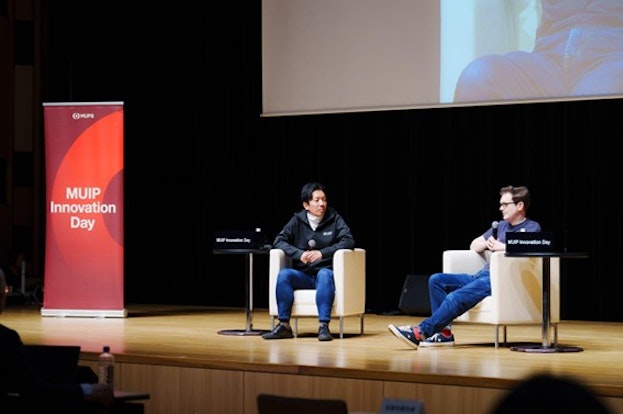
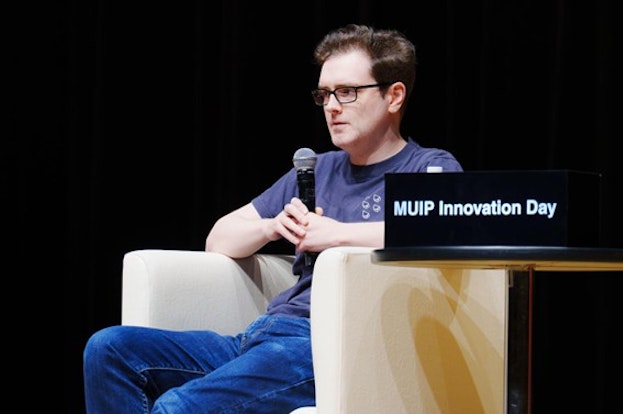
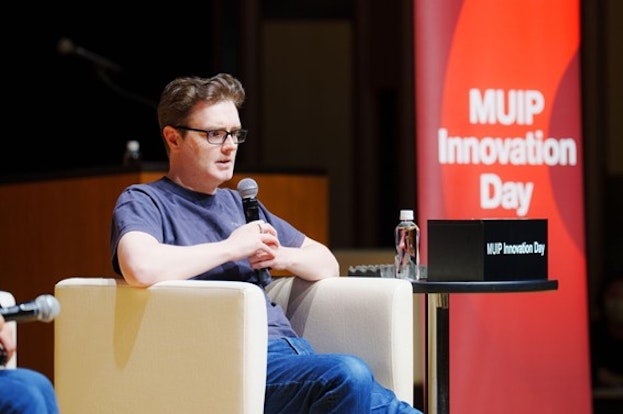
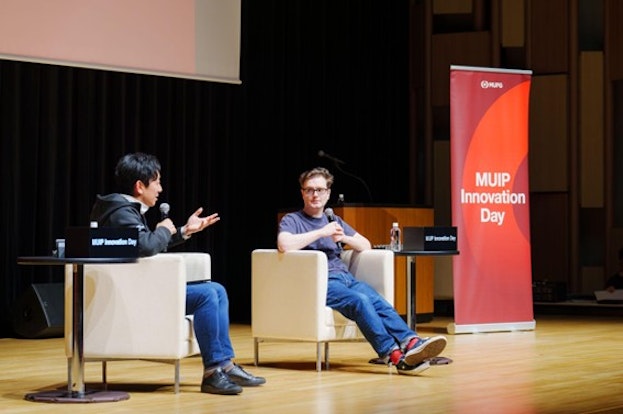
At MUIP Innovation Day on March 4, 2026, Llion Jones, Co-founder and CTO of Sakana AI, took the stage to discuss where AI stands today and where it is headed. The session was moderated by Takashi “Taka” Sano, Chief Investment Officer at MUIP. Drawing on his unique vantage point as one of the original co-investors of the Transformer architecture, Jones engaged in wide-ranging discussion covering the evolution of AI technology, its implications for financial institutions, and what kind of organizational environment produces innovation.
The AI trend is not a bubble
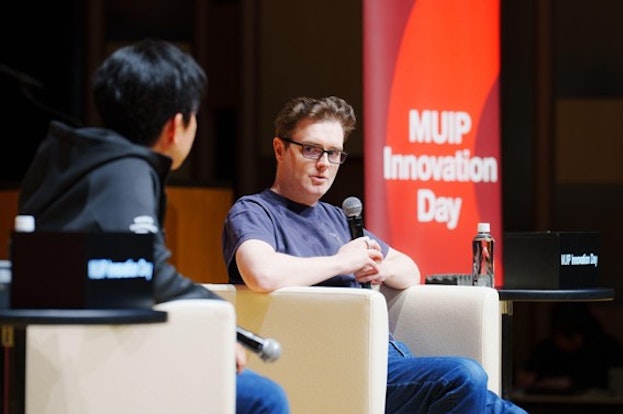
Taka opened the session by posing the question: “Is AI a bubble, or is it a breakthrough?” According to CB Insights data he cited, half of all global startup investments last year went to AI-related companies, and half of that amount was concentrated in just six companies, including OpenAI and Anthropic. Given this situation, it is a natural question to ask.
Jones pushed back on the bubble framing. The word ‘bubble’ conjures an image of something that can “burst very easily, and then all the value is gone”. That is an unsettling word for people with interest in finance. “I would maybe think of a balloon instead. Balloons can pop, but you’d have to go crazy.” The balloon right now is perhaps a little too big and will need some adjustment. While some players will lose value, I don’t think we are headed for disaster because AI is really creating a massive amount of value.”
As for why people feel it is a bubble, Jones offered this explanation: companies racing to bring AI products to market tend to overpromise. Devin, the autonomous software engineer, for example, could not actually deliver on its initial claims. However, systems that can now do what Devin claimed years ago do exist. It is this experience of early disappointment with AI technology that has fueled broader skepticism, yet the pace of progress is fast. Jones said, “you basically have to try the technology every month to know if it can now do things which was thought to be impossible last month.”
Two fundamental challenges facing current AI
Jones identified two important challenges that current AI has yet to overcome.
The first is data efficiency. Citing self-driving cars as an example, he noted that autonomous vehicles in California have become operational because sufficient data have been collected there, but a 16-year-old human learns to drive with “perhaps one-millionth of that data.”
This is a massive gap in AI capabilities. With the rise of hyperscalers, there’s a growing perception that if you run the entire internet through a Transformer, you’ll get close to human-level intelligence, and people have stopped worrying about this problem. But humans can achieve equivalent intelligence without needing to process that much data. There is enormous room for efficiency improvements, and far more researchers should be tackling this issue. (Llion)
The second challenge is the limits of generalization. Why can an autonomous vehicle trained in California not drive in Paris, when a human who learned to drive in California has the same capability to drive anywhere in the world? This gap, Jones argued, carries significant implications for financial institutions specifically.
There may be cases where we don’t have millions or hundreds of millions of data points for a specific client or business. There will be situations where we might want to perform analysis on a very small amount of data about a client, where if we had a million times the data, generative AI could produce excellent results. But without that data, it becomes a barrier. If data efficiency and generalization capabilities improve, enormous possibilities will open up for financial institutions. (Llion)
Post-Transformer research and “Greatness cannot be planned”
Jones’s public announcement that he is researching new approaches to replace the Transformer has made waves in the AI research community. He was quick to clarify, however, that this is not a repudiation of existing Transformer research.
I want to make it clear that I haven’t suddenly become anti-Transformer. There is still enormous value to be extracted from current research on Transformers. We are still seeing major advances in the fields of coding agents and automated software engineering. (Llion)
That said, Jones expressed concern that current AI faces serious problems with too few researchers addressing them. Some believe that simply continuing to scale will lead us to our destination, but Jones argued that “if there’s a breakthrough, we can get there far more efficiently.”
The philosophy that Sakana AI applies in its post-Transformer exploration is captured by the phrase “Greatness Cannot Be Planned” – a paradoxical approach that suggests it is better to proceed without a plan when searching for something truly interesting.
This philosophy gave birth to one of the company’s signature research outputs: the Continuous Thought Machine (CTM).
We knew that synchronization is important in the brain, so we added that to current neural networks. As a result, interesting characteristics began to emerge one after another. For example, we found that it was very well-calibrated in terms of self-assessed probability. Normal neural networks are poorly calibrated, but when the CTM judged something to be a cat with 80% confidence, it was actually correct 80% of the time. (Jones)
Rather than marching in a straight line toward a predetermined goal, discoveries come more readily when you pursue what is genuinely interesting. This, Jones suggested, points to something fundamental about the nature of innovation itself.
Artificial Super Intelligence in 2029 and the Singularity beyond
On the subject of artificial general intelligence (AGI), Jones offered a distinctive take. If we take the definition literally, Jones argued, AGI has arguably already been achieved with the arrival of large language models. The moment a system ceased to be limited to specific tasks and could attempt any task at all, the transition from narrow intelligence to general intelligence had occurred.
When people talk about AGI, I think they actually mean ASI (artificial superintelligence). ASI refers to an AI that is more intelligent than any human being on Earth across all possible tasks. (Jones)
Regarding the difficulty of predicting the future, Jones presented a striking data point: the computational power used to train AI models has been doubling every six months – a trend that has continued consistently since the 1970s and 80s.
If that doubling of compute resources every six months continued for ten years, exponential arithmetic implies approximately one million times the current computational capacity.
Futurist Ray Kurzweil predicted that human-level intelligence, or AGI, will be achieved by 2029, with the Singularity arriving in 2045.
Jones, who witnesses the pace of current progress daily, said he can “imagine” such predictions being right. The fact that even he, as a domain expert, is continually surprised to find that “something I couldn’t do a month ago, I can do now” speaks to the speed of progress.
The dramatic evolution of AI coding
Jones illustrated the rapid pace of progress through his own direct experience. When he first started the company, he attempted to develop a proprietary machine learning framework but abandoned the effort because he found it too complex. A year later, as vibe coding became increasingly relevant, he tried again – with Claude writing more than 95% of the code. In a matter of weeks, a genuinely usable prototype was complete.
However, during that process, Jones realized a better architectural approach and decided to start over. Taking advantage of a long weekend in Japan, Jones worked through the break and by the end of the weekend, he had a working prototype.
It went from something that would take months by hand, to something practical in weeks, to a working prototype over a weekend. This progress is insane. When I gave a talk on software agents a year ago, I was speculating about what they might become in the future and how we might collaborate with them. But for my team today, collaborating with agents is completely routine. You spin up ten agents that sit and write code, and the human orchestrates them. (Jones)
The discussion also touched on “AI Scientist,” one of Sakana AI’s signature research outputs on the question of whether AI can autonomously conduct end-to-end AI research. Initially it could not, but simply by waiting for the next generation of large language models was enough for it to suddenly become possible.
Two years on, AI-generated papers are being submitted to every AI conference, and it has become a major issue. Reviewers have gotten to the point where they find reading the papers too tedious and are now having AI read and review them. (Llion)
Jones expressed excitement about the potential for automated science to deliver remarkable results across a range of domains – including unsolved problems in physics and astronomy, the practical application of nuclear fusion, medicine and more.
The organizational environment that fosters innovation
It is well known that the Transformer was invented by multiple researchers working in an unplanned, unpredictable, and pressure-free environment. Jones’ thought-provoking perspective about what kind of environment actually generates innovation in the AI era.
With growing interest in AI and the inflow of talent and capital, you might think that this will create more innovation. But it may actually decrease. As pressure from investors for results intensifies and competition accelerates, researchers feel they have to rush to get their ideas out. (Llion)
Jones recommended giving 5 to 10% freedom to a small subset of teams to research without pressure. He acknowledged that for managers at large companies, granting that kind of freedom carries real risk and is difficult to do – but argued that the next breakthrough will inevitably come from exactly these kinds of long horizon bets.
At Sakana AI, they maintain a high degree of the freedom and low pressure environment that gave birth to the Transformer. The idea for AI Scientist also did not come from a top-down directive from management – it started when an individual researchers had the courage to ask the question: “Is automated science possible now?”
Already “quite close” to autonomous task completion
Toward the end of the session, when asked when AI will reach the point of completing tasks without human intervention, Jones replied: “It already feels like we’re pretty close.” As an example, he described asking Claude Code to handle a Swedish translation for his father. Claude Code completed the task in 20 minutes – and in the process encountered an API key issue, independently found a free alternative service, and resolved numerous error messages on its own.
By around 2029, human intervention will be minimal for many tasks. I encourage everyone in this room start learning how to interact with these assistants right now. (Llion)
He also introduced a phrase that has become widely-cited: “You may not lose your job to AI itself, but you may lose it to someone who uses AI.”
The session with Jones – known to the world as one of the original co-inventors of the Transformer – offered attendees a vantage point that only a researcher at the absolute frontier of AI technology could provide.
